Marketing Strategies During Recessions And The Credit Crunch
Introduction
Introduction
Marketing strategy has played a pivotal role in a firm's success during previous recessions and the current credit crunch. During economic recessions consumers spend less and lower market prices often lead to reduced profit margins. In an extremely competitive market place many businesses struggle to survive. If a business can thrive during a recession then it is likely to be successful no matter what the challenges are. This article is about common marketing strategies adopted by businesses during recessions.
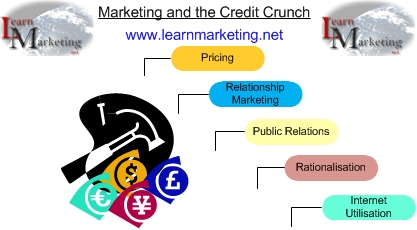
The diagram below shows 5 marketing strategies firms can use during recessions and difficult trading conditions.
Pricing
The price of a product or service is important to consumers during recessions as they are often dealing with reduced incomes and reduced credit facilities. Price is an important element of the marketing mix, during the current recession many businesses in the UK have used price as a way to promote their products. Prices have either been reduced, cheaper product ranges have been introduced or existing value products are used in promotional activity. For example many supermarkets in the UK have "value ranges".
- Tesco: Everyday Value
- Waitrose: Essentials Range
- Morrisons: M Savers
- Sainsburys: Sainsburys Basics
- Asda: Smart Price
In September 2008 Tesco introduced a price marketing campaign which included the strap line "Britain's Biggest Discounter" and in the latter months of 2008 Aldi's strap line of "spend a little live a lot" emerged in their marketing activities. Sainsbury's current strap line is "living well for less".
In 2008 BOGOF (buy one get one free) offers moved away from the traditional boundaries of retail stores and into other businesses such as car manufacturers. In response to falling demand from consumers some car dealers and manufacturers such as Mazda and Kia offered BOGOFS on brand new cars!!
Another common strategy is to add one day sales to the traditional retail shop sale calendar. During the one day sales most products in store are reduced by a certain percentage e.g. 20% of the current price. This strategy has proved very successful in the UK for companies like
Marks and Spencers and Debenhams.
Relationship Marketing Strategies
Whilst price is crucial in attracting new customers in the current economic climate, good customer service is essential for customer retention. For example UK store John Lewis has fared well during the credit crunch, excellent customer service promoted through a good staff training programme has ensured that customers still continue to shop there. Prioritising customer service will increase customer loyalty and not only support a business during recessions but also reap long-term awards as customers continue to shop with those businesses once the credit crunch is over and consumer's disposable income has increased.
Rationalisation
All businesses should regularly review operations and deal with inefficiencies. This will reduce costs and wastage. During recessions rationalisation such as disposing of non profitable business activities or unproductive premises and unnecessary staff are more important than ever. In the current economic slowdown many governments have reduced the number of people working for them and private companies have implemented large scale redundancies. For example in August 2012 the insurance firm Aviva announced that it plans to cut up to 800 jobs to save operational costs. This part of Aviva's programme to reduce costs by £400 million. Although not a marketing strategy, rationalisation is an important strategy if a firm wants to survive during difficult times, and focus its effort on surviving.
From "Bricks and Mortar" to "Clicks and Mortar"
In addition to access to businesses through the telephone and premises, clients expect an internet website. In today’s internet age, websites are a crucial way to reach customers as demonstrated by reports showing a decline in high street spending and increases in online spending. Some businesses have taken this a step further by transferring their whole business onto the internet in a bid to reduced costs during difficult business conditions. For example DSG Retail Limited moved their shops Dixons Retail from the high street and onto the internet.
An online business has many benefits including the ability to action amendments in real time and through lower costs than implementing change across “bricks and mortar” businesses. However from a marketing perspective a website business has its own challenges. In addition to the websites appearance and ease of navigation for the consumer “surfing” through the website, the site needs to be search engine friendly. An online business does not have the luxury of the consumer locating them often inadvertently) whilst walking down the high street. If the website isn't search engine friendly the site is likely to be visited only by consumers who know the website's address. With the high
level of competition in the online business world, a business is unlikely to survive without good search engine ranking or effective marketing
strategies. Firms focus heavily on website marketing to maximise search engine listing. Google AdWords is a popular service offered by Google where firms can pay to have their services are ranked in the top ten search listing when certain key words are searched for. Click here here to learn more about internet marketing.
Public Relations
Firms have to be economical with their marketing spend, public relations (PR) is becoming more popular during the credit crunch. Public relations is the process of getting the company brand into the media for little or no cost. This is becoming more popular as firms tighten their marketing budgets. Richard Branson with his Virgin brand is a company that uses this strategy regularly, from crossing the Atlantic in record time using the Virgin Challenger, to bungee jumping off a building.
How have governments supported firms with marketing strategy?
In 2009 falling new car sales prompted some governments to offer money towards the purchase price of a new car if purchasers traded in their old car. The idea of these schemes was two fold:; to encourage new car sales and to replace old cars with new fuel efficient/more environmentally friendly cars. In Germany demand for new cars increased around 45% in the first month of the scheme and in the UK between May and November 2009 more than 250000 cars were part of the scrappage programme. The car scrappage scheme is an example showing how firms can benefit their business by lobbying governments for help during difficult trading conditions.
Conclusion
Businesses will always face challenging conditions whether that is new competitors entering the market, natural disasters or economic recessions. The difference between a successful business and a business that went " bust" is how well they dealt with the challenges. Difficult trading conditions are not an excuse for poor performance; it is an opportunity to show why you are better than your competitors.