Ethical marketing is about making marketing decisions that are morally right. The morality of the marketing decision can encompass any part of marketing including sourcing of raw materials, staff employment and product advertising and pricing. Each person's view of morality is different, it is based on personal values and experiences. This creates a challenge for companies who want to pursue ethical marketing in a manner that will appeal to their target market.
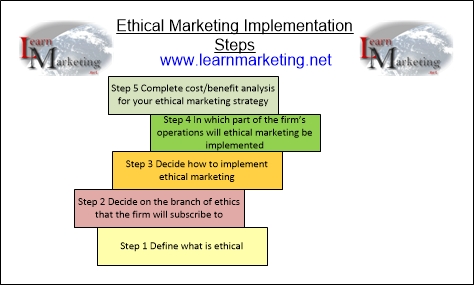
This diagram illustrates the steps you need to take when implementing ethical marketing
Examples Of Marketing Decisions Involving Ethics
Does the firm exaggerate the benefits of its products on packaging. Are claims overstated? Many firms make bold claims to help sell their products. Are such claims morally wrong or merely "advertising puff".
Is it morally wrong to adopt high pressurised sale techniques or to focus on vulnerable customer groups e.g. pensioners? On the other hand vulnerable customer groups have needs? Can you get such customers to buy without pressurised selling?
Firms need to make profits, a reduction in production costs increases profit margins. Is it morally wrong to negotiate tough contracts with suppliers to reduce production costs when it will reduce the supplier's profit margin?
Is it morally wrong to disregard the impact of business activities on the environment. To find out more about environmental marketing Click Here.
Why Do Businesses Adopt Ethical Marketing?
Some businesses are set up because the founders feel strongly about an issue and they would like to deal with issue through the business. Whilst other businesses pursue ethical marketing because they feel that is what customers expect from them.
Some consumers buy products and services because they feel that the products are based on ethical strategy they agree with. In response to this consumer demand organisations have increased their focus on ethical marketing. The UK Co-operative bank is good example of an organisation which endeavours to adopt ethical principles.
How Do Companies Begin the Ethical Marketing Process?
After a company has decided to implement ethical marketing it will
need to make the following decisions:
Define what is ethical.
Decide which branch of ethics it will subscribe to.
Decide how ethical marketing will be implemented.
In which areas of the firm's operations will ethical marketing be implemented e.g. employees, suppliers, consumers/clients, production techniques, distribution or the whole value chain.
Complete an analysis of how much ethical marketing will cost and compare this against the likely benefits of ethical marketing. This will help them decide whether they would like to pursue ethical marketing.
Challenges of Ethical Marketing
Ethical marketing requires marketing strategies that are ethical and reflect consumer expectations. It is not easy to define the term ethical or identify which ethical decisions cater to market expectations. An individual's view of ethics and morality is influenced by a variety of things including their culture, family upbringing, peers, community, religion and country.
Balancing ethics and remaining competitive can be difficult. If ethical marketing involves considering the needs and welfare of suppliers, employees and customers it could add to business costs. For example "Fair Trade" products provide producers with a minimum price. When business costs increase profit margins reduce or the costs are passed onto customers through price increases. However if firms can adopt ethical marketing which reflect market expectations, it may make them more appealing to customers and therefore create a competitive edge.
Ethical Marketing Conclusion
Ethics can form one element of a firm's marketing strategy or the whole strategy can be based around ethical marketing. It all depends on what the business is trying to achieve and what they feel is expected by customers, shareholders and their target market. Ethical marketing can increase business costs or create a competitive edge.
Studying Business Management visit www.learnmanagement2.com