Firms use perceptual or positioning maps to help them develop a market positioning strategy for their product or service. As the maps are based on the perception of the buyer they are sometimes called perceptual maps. Positioning maps show where existing products and services are positioned in the market so that the firm can decide where they would like to place (position) their product. Firms have two options they can either position their product so that it fills a gap in the market or if they would like to compete against their competitors they can position it where existing products have placed their product.
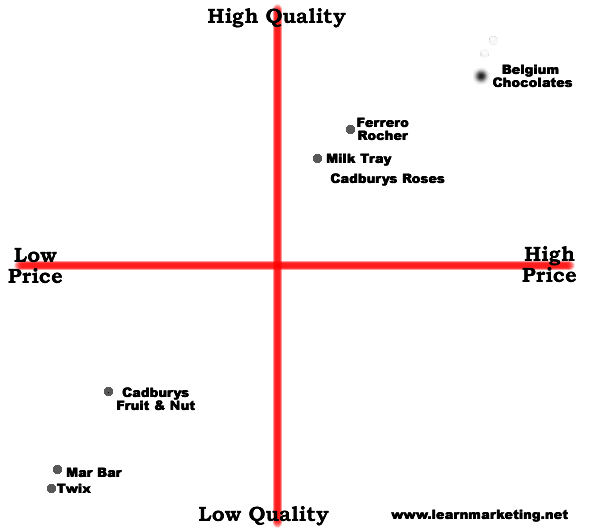
The diagram below is a Perceptual Map of UK chocolate confectionery Brands
Drawing a Perceptual (Positioning) Map
Theoretically a perceptual map can have any number of lines, to keep things simple they usually have 2 lines the x and y axis. The x axis goes left to right and the y axis goes bottom to top. Any criteria can be used for the map for example price, quality, status, features, safety and reliability. Once the two lines have been drawn and labelled existing products will be placed onto the map.
Example Perceptual Map
In the example below two dimensions price and quality have been used. If we plot the UK chocolate
market, we can identify where existing chocolate brands have been positioned by manufacturers.
For example our fictional brand of Belgian chocolates called Belgium Chocolates are high quality and high price so they are placed in the top right hand box, whilst Twix
is an affordable "every day" treat chocolate so it has been placed in the bottom left hand square, in the low quality low price brand box.
The Purpose Of Perceptual Maps
Perceptual maps can help identify where (in the market) an organisation could position a new brand. In our example this could be
at the medium price and medium quality position, as there is a gap there. There is also a gap in high price low quality but consumers will not want to pay a lot of money for a low quality product. Similarly the low price high quality box is empty because manufacturers would find it difficult to make a high quality chocolate for a cheap price or make a profit from selling a high quality product at a low price.
Summary
We must remember that perceptual maps are based on the buyer's perception this is challenging: what may be viewed as a quality product by one buyer, may not be perceived as a quality product by another buyer. Perceptual maps help firms understand how customers view their products. However as perception is very subjective, firms need to ensure that the data they use to plot the map is accurate. If customer perception data is wrong, the map will be wrong and this will affect the success of any marketing strategy based on the perceptual (positioning) map. Perceptual maps may help organisations identify gaps in the market. Before deciding to fill any gaps in the market firms need to ensure that there is likely to be a demand for a product positioned in that gap.
Studying Business Management visit www.learnmanagement2.com