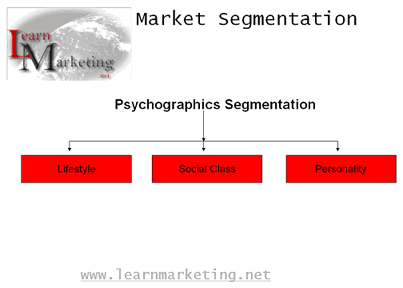
Although demographic segmentation is useful, some marketers use psychographics segmentation in the hope that this will improve the accuracy of their segment profiles. As illustrated in the diagram above, Psychographics segmentation can be broken down into lifestyle, social class, and personality characteristics.
Lifestyle Segmentation
The Oxford English dictionary defines lifestyle 'as a way of life'; lifestyle segmentation aims to examine the way people live. Our lifestyle every day activities, interests, and our opinions and beliefs dictate who we are. Marketers refer to these as AIOs (Activities, Interest and Opinions), and our AIOs dictate our everyday behaviour from where we shop, to what we buy. Marketers aim products and services at particular lifestyle groups and develop lifestyle profiles based on their target market. If we understand the lifestyle of a particular group we can sell them product and services to enhance their lifestyle.
The picture below contains two examples of lifestyle groups "yuppies" and "third agers".
A lifestyle group is a particular segment of the market; businesses that are marketing a product or service will select the lifestyle group that they would like to aim their products at. Individuals within a lifestyle segment have or display similar characteristics. For example in the early 1980s when the UK economy was booming the City of London employed young independent staff on very high salaries. The media termed this group of employees as YUPPIES; they were young upwardly mobile professionals, associated with mobile phones, money, expensive cars, and prestigious city jobs.
Third agers are another group termed and identified by the marketing industry. They are people in their 50s, retired from a profession, have a high disposable income and spare time . Many third-agers are adventurous and experimenters, as they have spent their lives working hard and now seek enjoyment from life. Third agers have income available to spend on expensive and luxury items.
Personality Characteristics
Products and brands can also be aimed at particular personalities. Piaggio motorcycles are aimed at young 18-25 outgoing, independent persons. Often marketers try to develop personalities for their brands and products that mimic that of their target market. Ask yourself if Nike or Levi’s was a person, what type of person would they be?
Social Class Segmentation
Social class segmentation divides society into 6 distinct groups based solely on occupation:
A Professional staff
B Middle management
C1 Junior management
C2 Skilled manual
D Semi-skilled and unskilled workers
E Those dependent on the state
Social class segmentation works on the assumption that the higher your profession the higher the income and more affluent the lifestyle.